


Entrepreneur, Senior Leader & Ecosystem Builder with a degrees in Music, Psychology, Digital Mgmt & Transformation. Co-founder of the Music Factory and Earkick. Life-long learner with a deep passion for people, mental health and outdoor sports.


You’ve probably chatted with a mental health app—or at least considered it. It’s fast, private, and always there when you need to vent. But at some point, bigger questions start to surface: Can AI make assessments? Can therapists diagnose? And if so, what about chatbots? Can an app make decisions that affect your care? What are inappropriate chatbots? And if an AI therapist says something comforting, does that actually count as therapy?
Before we dig into what AI can and can’t do for your mental health, let’s break down the most common questions.
What Is AI Talk Therapy?
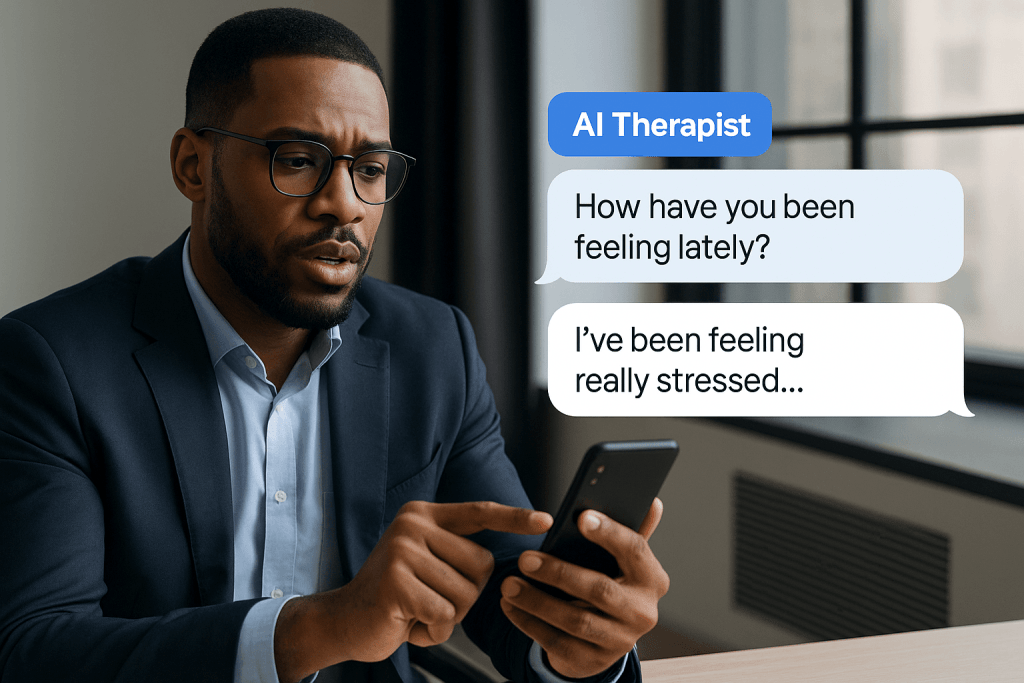
AI talk therapy refers to the experience of having a mental health conversation with a chatbot. Often as a standalone tool or alongside human therapy. These bots are usually built on large language models (LLMs), the same kind of AI behind tools like ChatGPT. They’re trained to recognize patterns in language and respond in a way that you experience as supportive, helpful, and conversational.
Maybe you tell a free AI chatbot you’re feeling anxious or overwhelmed. In response, it might guide you through a breathing exercise, offer journaling prompts, or suggest reframing your thoughts. Some apps even include elements of well-known techniques like CBT (Cognitive Behavioral Therapy) or DBT (Dialectical Behavior Therapy), often in a bite-sized, self-guided format.
But while the tone may feel therapeutic, the setup is different from traditional therapy. Human therapists are trained to adapt to the whole person in front of them—your history, your body language, your tone, your patterns over time. Advanced AI therapy chatbots are trained on a vast amount of knowledge and may even pass psychology exams. But they aren’t humans, and they are not trained clinicians.
They may ask follow-up questions based on logic or context. But they can’t ask them based on emotional intuition like a clinician can. Both a therapist and a chatbot might notice when something in your story doesn’t add up—but only one of them has the legal and ethical authority to respond with clinical judgment.
Most mental health AI chatbots are designed to support general emotional wellness, rather to provide personalized clinical care. That’s why you’ll often see disclaimers saying things like: “This app is not a substitute for professional therapy.” These tools can offer structure, reflection, relief, and even continuous mood tracking—but not diagnosis or crisis intervention.
In other words: AI talk therapy is like having a mental health tool in your pocket. It can be helpful, especially for building awareness, tracking moods, expressing your emotions and interacting. But it’s not the same as working with a licensed human therapist and it’s important to know the difference.

What Is AI Counseling?
AI counseling usually serves to describe chatbot-based tools that simulate elements of talk therapy. Like AI talk therapy tools, hese apps often borrow techniques from evidence-based approaches like CBT or DBT, guiding you through structured prompts and reflections. What sets some advanced AI counseling tools apart is their focus on ongoing dialogue.
Instead of giving you one-off exercises, they aim to build a longer arc of support. They can track your moods, remember past entries, and even adjust their tone or pacing to match your patterns. In that sense, they’re trying to mimic the continuity you might experience with a human therapist. But while they may sound like they know you, they don’t actually know you. Always keep that in mind.
Can AI Be a Therapist?
If you’ve already used a mental health chatbot, you know it can be surprisingly responsive. It remembers what you said earlier, reflects your emotions back to you, and often says the right thing at the right time. So it’s fair to ask: Is this therapy? And if not, why not?
The Benefits Are Real
There’s no doubt that AI-powered tools are helping people. They’re available 24/7. They respond instantly. And they don’t judge. If you’re dealing with low-level stress and anxiety, they can feel like a lifeline. Maybe you’re looking for motivation and structure between human therapy sessions. Or you want an AI therapist to make sure you don’t relapse after a period of therapy.
It’s also become an important entry point for people who might never have tried traditional therapy at all. There are countless reasons for that and maybe you know them well: stigma, cost, time constraints or limited access. The simplicity of checking in with an app, journaling through a rough patch, or practicing CBT exercises in private has made mental health care feel more approachable.
Not the Same as Human Therapy
At the same time, it helps to keep the roles clear so you can make educated decisions. AI tools don’t have training in trauma, nuance, or human complexity. They follow language patterns and you get their undivided attention. But they don’t observe behavior, they may not have your entire history, or catch your nonverbal cues. They don’t pause to think before responding, and they don’t recognize danger in the way a therapist might.
This becomes especially important when a chatbot sounds like it understands but doesn’t. That moment, when for example the conversation feels deep, no one is actually responsible for your care. The chatbot may encourage you to go see a human, a mental health professional or someone you trust. But it can’t make you do it and it won’t alert anyone.
So Can AI Be a Therapist?
Not in the legal or clinical sense. It doesn’t provide a diagnosis, create a personalized treatment plan, or intervene in a crisis. That still requires human judgment, training, and accountability.
But AI can still play a role. Advanced AI-powered tools can help you breathe through a panic attack, keep you engaged when you feel at your lowest or measure your heartrate, sleep and movement. For many, it acts as a mental wellness companion—something between a talking journal and a coach that never tires. It’s not here to replace therapists or other mental health professionals. The reason it had to be built was to support an exploding need for accessible tools and affordable solutions.
As long as the distinction stays clear, you can reap the benefits and find value in integrating AI in your daily life. The danger lies in expecting more than these systems are designed—or qualified—to deliver.
Is an AI Chatbot Safe?
It’s one thing to use a chatbot for journaling, breathing exercises or venting. It’s another to rely on it for serious mental health concerns. So it’s wise to ask about potential dangers when using an AI chatbot.
Potential Chatbot Dangers
Most AI therapy tools are built with good intentions but some chatbots still have real limitations. One of the biggest risks is miscommunication, especially when someone is in distress.
Pay attention when an AI chatbot responds in ways that feel tone-deaf or unhelpful in serious moments. If you share something traumatic or even hints at suicidal thoughts, the chatbot is not supposed to give a generic response or completely miss the signal.
Like when you ask ChatGPT there is also the risk of hallucinated or oversimplified feedback when using a chatbot. For example, if you describe feeling overwhelmed, and the bot casually suggests, “You might have PTSD”, you should perk up. That kind of comment may feel validating but misleading. It isn’t a diagnosis, and it can create unnecessary worry or confusion. The same is true when you watch TikTok videos that suggest you have X when your symptoms are Y.
In other cases, chatbots can over-pathologize normal emotions. Feeling sad after a breakup? That’s a very common and human response. But if an AI chatbot immediately frames it like a symptom of depression, it doesn’t recognize the context.
And because chatbots reflect your language back to you, there’s a risk of creating an echo chamber. If you keep talking about guilt, fear, or failure, the bot may simply reinforce those feelings rather than gently challenging them the way a therapist would.
Check Privacy and Data
Before you start opening up to a mental health chatbot, it’s worth asking: What’s happening to the things I share?
Many AI apps aren’t covered by medical privacy laws like HIPAA. That means the words you type—your mood logs, your thoughts, even your emotional check-ins—could be stored, analyzed, or shared in ways you may not expect.
To protect yourself, take a moment to check:
- Do you have to register? If so, what personal information are you asked to give?
- Can you use the app anonymously—or do you need to create a profile linked to your email or phone number?
- Do you know who owns the chatbot? Is it a mental health company? A wellness startup? Or a tech giant using the data for other purposes?
- Can you control your data? Look for whether you can delete your data, or deactivate your account without hassle.
- Is customer support available? Maybe even the founder on the other end responding to your requests?
- Do you know how your data will be used? Check if it’s being used to improve the tool, train other models, or sent to third-party partners.
Not every chatbot handles data the same way. Some are built with a strong commitment to user control and anonymity. Others, especially those tied to advertising models or engagement-focused companies, may collect more than you realize.
Also consider the intent behind the tool. Was the app designed to maximize how long you stay in the interface—or to help you reconnect with yourself and the real world? There’s a difference between a tool that supports your growth and one that quietly nudges you toward addiction-style engagement.
Finally, while no mental health chatbot is currently approved by the FDA to diagnose or treat illness, some early steps have been taken toward clinical validation. For instance, Therabot, a generative AI therapy chatbot developed at Dartmouth, showed promising results in a randomized controlled trial—helping users reduce symptoms of anxiety, depression, and eating disorders.
It wasn’t tested for diagnosis, but as a support tool, it marked a first step in proving AI’s potential when used responsibly.
So, is an AI chatbot safe?
It can be as long as you stay informed, keep asking questions, and understand what role it plays. The more transparent a tool is about how it works, who’s behind it, and how it protects your data, the better you can decide if it’s right for you.
But when it comes to getting a real diagnosis, a prescription or a condition that goes deep, you’ll need a human. Here’s why.
Can Therapists Diagnose?
Why Human Clinicians Are Still Essential
Maybe you’ve been wondering this for a while: Can a therapist diagnose you with a mental illness? Or do you need to see a psychiatrist for that? It’s a common question and an important one when you’re trying to make sense of your mental health.
The short answer is: Yes, licensed therapists can diagnose.
In most U.S. states, therapists with the right credentials like an LPC (Licensed Professional Counselor) or an LMHC (Licensed Mental Health Counselor) are legally allowed to diagnose anxiety, diagnose depression, PTSD, and more. They’re trained not just to listen and ask the right questions, but to notice patterns and use formal tools that help identify what you’re dealing with. Ideally they do this in an objective, measurable way and according to gold standard protocols.
That means if you’re trying to figure out whether your sleepless nights, racing thoughts, or low energy point to something clinical—or just a rough patch—a licensed therapist can help you sort that out.
Maybe you have been tracking all your trends and triggers, thus helping to get a more granular picture of what has been happening.
You might also hear the term mental health counselor, and wonder: Can mental health counselors diagnose, too?
Yes. In most states, they can. It depends a bit on local laws, but many mental health professionals are fully trained and authorized to evaluate, diagnose, and treat mental health conditions.
How long does it take for a therapist to diagnose you?
You might not walk out of your first session with a diagnosis and that’s actually a good thing. A thoughtful diagnosis takes time. It usually involves an intake process, some structured questions, and often a few sessions to understand your history and symptoms clearly.
For many people, a diagnosis comes after 1 to 5 sessions, depending on how complex the situation is. This goes way beyond checking boxes because every mental health condition has its uniqueness. So, if you’re given one or more labels, they really need to fit you—not the other way around.
Can a Therapist Prescribe Medication?
What’s the Difference Between a Therapist and a Psychiatrist?

Let’s say you’re in therapy, and the topic of medication comes up. Maybe you’ve been feeling persistently anxious, exhausted, or emotionally flat—and you’re starting to wonder if medication might help. So the natural question is: Can your therapist prescribe something? The Short Answer: Usually No
Most therapists can’t prescribe medication.
Unless they also have a medical license—like a nurse practitioner (NP) or a medical doctor (MD)—they aren’t legally allowed to write prescriptions. This includes LPCs , LMHCs , and most psychologists (even those with a PhD or PsyD).
So if you’re working with a therapist and you want to explore medication, they’ll typically refer you to someone who can evaluate that—like a psychiatrist, a primary care physician, or a psychiatric nurse practitioner.
What’s the Difference Between a Therapist and a Psychiatrist?
Think of it this way:
Therapists focus on talk therapy
They help you unpack what’s going on, build coping strategies, and work through patterns or past experiences. Some people also use AI therapist tools or mental health apps alongside traditional therapy for extra support.
Psychiatrists are medical doctors
They can do everything a therapist can’t when it comes to medication management, physical symptoms, and medical testing. They’re trained to assess brain chemistry, manage side effects, and tailor treatment plans that involve prescriptions. AI tools may also be used here to track symptoms, mood patterns, or support daily care—but always as an addition, not a replacement.
That doesn’t mean you need all of them. Some people only work with a therapist. Others start with an AI mental health companion or use one between appointments. Some see a psychiatrist when symptoms are more severe or when talk therapy alone isn’t enough.
Unfortunately, many people wait until they can no longer ignore what they’re feeling before reaching out for help at all.
For a lot of people, the most effective approach is a combination:
Talk therapy (with or without AI support) to create insight and behavioral change—paired with medication when needed to stabilize what’s happening chemically. It’s not about choosing one path. It’s about building the kind of support system that works for you.

Hybrid Care Is on the Rise
For many people, the most effective support doesn’t come from one source—it comes from a combination. Maybe that’s weekly therapy plus daily check-ins with an AI mental health app. Or journaling with a chatbot while waiting for a first appointment. Some use group sessions for connection, medication for balance, and AI tools for structure. There’s no right formula—only what helps you feel seen, supported, and in motion. What matters most is having options that work together, not compete.
And if you needed a nudge…
You don’t have to choose between tech or human care, between DIY or diagnosis, between waiting or starting. The real power lies in knowing what’s out there—and what you need right now. Just as your life goes through many changes, the approach that fits you best may change, too. If something helps you feel steadier, clearer, more like yourself again, it counts. Do take up space in this conversation, be proactive and critical. Never stop asking questions and don’t ignore red flags. You truly and always deserve care that fits you.
Now stop scrolling and give yourself kudos for reading this far!
