
Taking care of your mental health should not feel like a burden. In a brand new, busy world, you juggle work, your own family, and everything else in between, and it’s easy for pressure to accumulate. That’s where mental wellness AI tools come in; they’re like gentle guides that seamlessly fit into your day, presenting easy methods to check in with your emotions and create healthful habits.
These tools are not about fixing the whole thing overnight; They are right here to aid you as you nurture your emotional well-being. In this article, we’ll explore how AI equipment for mental wellness can emerge as part of your daily routine, making self-care intuitive and beneficial.
How AI Tools Support Your Mental Wellness Every Day
You might be surprised that time plays a role in something as private as mental health. The accurate information is that AI tools for mental health are designed with you in mind. They use clever styles from records to observe while you’re feeling off and recommend small steps to boost your mood. Unlike rigid apps from years ago, modern options examine your inputs, adapting to your needs.
Think about it: when stress creeps in during a hard workday, you do not constantly have time for a full remedy consultation. AI health companions can provide brief insights, like respiration reminders or mood trackers, right out of your phone. Studies show that constant small practices, supported by these tools, can lower tension and improve your sense of calm over time. They’re no longer a substitute for professional assistance, but they make it less difficult to live consistently with self-care.
By incorporating AI tools for mental well-being into your daily routine, you give yourself a compassionate ally. Whether you start your day with positivity or end it with prompts for reflection, these tools help you feel more in control and understood.
How AI Tools Enhance Your Self-Care Toolkit
Before we take into account specific options, let’s talk about how to select mental AI tools for mental well-being that work for you. Look for tools that feel comfortable to use, with no steep learning curves or confusing setups. We respect your privacy and will let you control what you share. Start small: Choose one or two that fit your needs, like better sleep or managing daily concerns.
Here’s a quick guide to getting started:
- Assess first, then choose the right support tools.
- Limit use to 10–15 minutes a day to avoid burnout.
- Check in after a week and adjust accordingly.
5 AI Tools for Mental Wellness to Try Today
These tools are available for your telephone or laptop, regularly priced or with basic versions. Each one makes a speciality of realistic aid, helping you construct emotional electricity every day.
1. AI-Powered Mood Trackers
Mood trackers use AI to track your daily behaviors and discover patterns in your emotions. They ask simple questions like ‘How are you feeling right now?’ Over time, trends emerge, including when stress peaks after busy meetings.
This helps your mental well-being by providing clarity, so you start to see what causes low moods, like lack of sleep, and what improves them, like taking a short walk.
Everyday example: At night, you might spend a few minutes logging your mood in an app. If it notices you’re often tired on Wednesdays, it might suggest a quick stretching routine. After a few weeks, you’ll gain greater awareness and be more proactive about your emotional ups and downs.
2. AI Journaling Companions
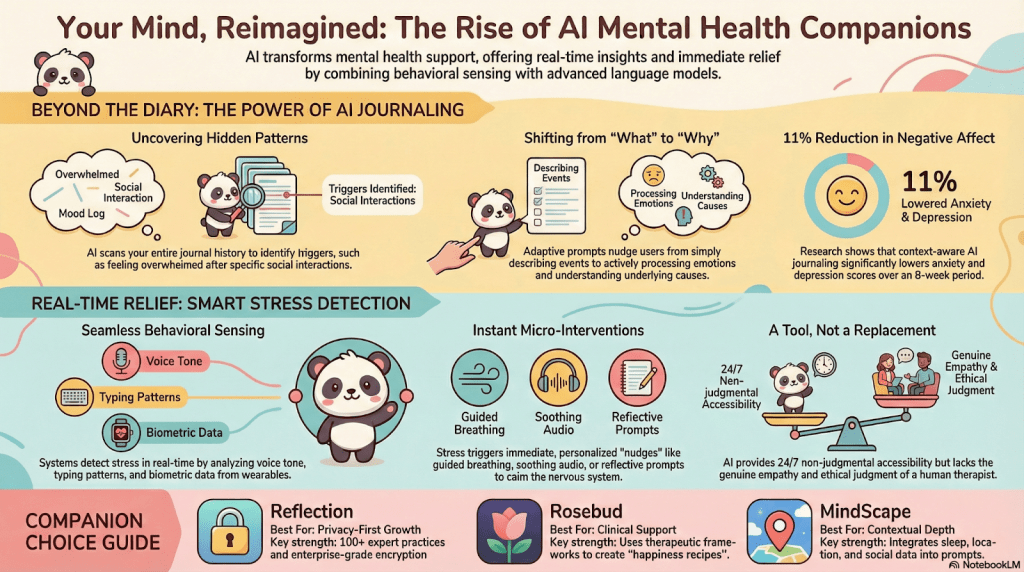
These tools act like a clever diary, asking you simple questions and summarizing your thoughts in patterns. You write candidly about your day, and AI highlights topics like gratitude or habitual pressure without being judgmental.
They boost your mental health through encouraging contemplation, which research links to much less stress and greater resilience. It’s like having a patient friend who allows you to process feelings, help you ask clearer questions and reduce rumination.
Everyday example: Before you go to bed, write down 3 things from the day. The device might reply: “You’ve stated feeling thankful for coffee chats twice this week. Might you want more messages like this?” Use it at night to relax and experience lighter whilst you awaken in the morning.
3. AI Breathing and Calm Guides
Breathing Guides uses AI to create customized sessions primarily based on your heart rate or voice input. They adjust the rate and duration to help your pressure stage and guide you through inhaling and exhaling.
It helps your mental fitness by quickly activating your body’s relaxation response, reducing stress instantly. Regular use builds a habit of staying calm, assisting you in coping with triggers like traffic or arguments more easily without problems.
Everyday example: Feeling crushed at lunch? Open the app for 1 minute of guided breathing; it detects your fast breathing and slows it down. Do this throughout the breaks, and you will quickly notice less anxiety and a calmer mood.
4. AI Habit Builders for Wellness
Habit developers track your self-care goals, like ingesting water or stepping away from screens, using AI to send tailored reminders and celebrate progress. They predict slip-ups based on your patterns and nudge you lightly.
They enhance your emotional well-being through turning true intentions into automated exercises, which combat stress and build self-confidence. Small wins release feel-good chemicals, helping you feel more optimistic each day.
Everyday example: Set an intention for 10 mins of studying daily. The AI notices if you skip evenings and suggests mornings instead, with fun streaks like ‘3 days strong!’ Integrate it into your morning coffee routine for lasting calm.
5. AI Gratitude and Positivity Prompts
These tools send daily AI-generated questions to focus on positive things, like “What made you smile today?” They learn from your responses to refine suggestions, creating a feed of uplifting content.
They nourish your mental well-being by shifting attention away from negative thoughts and promoting gratitude, which science suggests reduces symptoms of depression. Over time, you rewire your brain towards optimism, making challenging situations more manageable.
Daily example: During your commute, respond to a prompt like “Name a good deed you saw.” The tool creates a weekly summary: “You have noted 7 smiles this week!” Check it on Sunday to end the week on a positive note.

How to Integrate AI Tools for Mental Wellness
Now that you know these tools, how do you make them stick? Start with the one that resonates most, maybe the mood tracker if you want to explore your patterns. Pair it with non-tech habits, like a walk in nature, for balance.
Create a simple daily flow:
- Morning: Use a positivity prompt to set a hopeful tone.
- Midday: Use a quick guided breathing session at lunch.
- Evening: Journal or habit check-in to reflect.
If a tool seems off, turn it off. There’s no one-size-fits-all solution. Remember, mental wellness AI tools shine when they’re your assistant, not the star. Pair them with talking to friends or seeking therapy for deeper support. Many users use creative work such as painting, designing and visual storytelling, to boost their mental health. At the same time, they explore broader AI-powered video creation tools, while always remaining the hero of their creation process. They make the tools a supporting part of their digital wellness and productivity routines.
Watch for signs that the tools you choose are actually helping: more restful sleep, less spiraling anxiety, or just feeling more like yourself. If privacy concerns you, you can go through the app settings and select apps with strong data protection.
A Simple Routine You Can Actually Keep
There you have it, AI tools for mental well-being are here to walk with you, providing daily prompts towards peace and joy. From mood trackers that reveal your patterns to gratitude activities that enliven hard days, these 5 tools can be seamlessly integrated into your life, helping you manage stress and include self-care.
Take one small step nowadays. Get familiar with available tools via dedicated websites such as AIChief.
Download a mood tracker or breathing guide and try it for five minutes. You are the hero of your wellness story, and those tools are simply supportive companions to make your journey less complicated. Celebrate each bit of progress, irrespective of how small.
